
In local government, open dialogue is not just a workplace nicety, it’s a critical driver of transparency, accountability, and service quality. Councils operate in a complex environment where decisions affect entire communities, and where resources are often stretched. For this reason, employees must feel confident to raise issues, suggest improvements, and voice concerns without fear of negative repercussions. When staff are hesitant to speak up, problems can go unresolved, opportunities for innovation are missed, and trust in leadership can erode.
Encouraging a culture where speaking up is normal benefits not only employees but also the communities councils serve. It strengthens governance, fosters inclusivity, and ensures diverse perspectives are heard before decisions are made.
Our Australian local government data from over 25,000 responses reveal a nuanced picture of employee sentiment towards the statement: “I am comfortable speaking up and raising issues.”
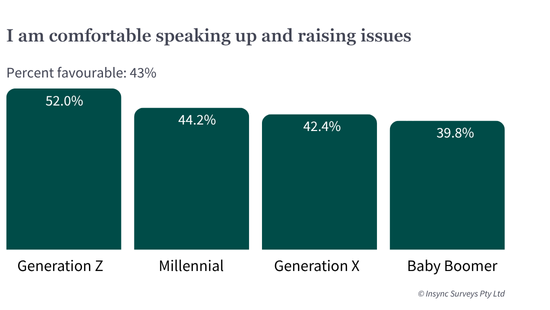
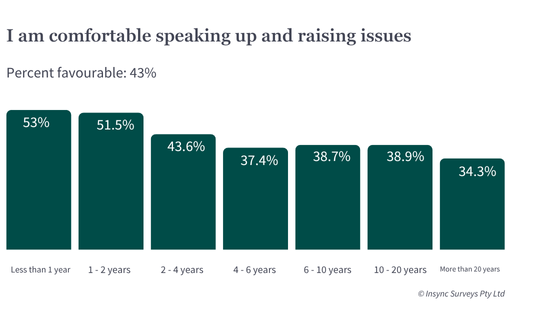
Interestingly, there is hardly any difference in the results when split by organisation size.
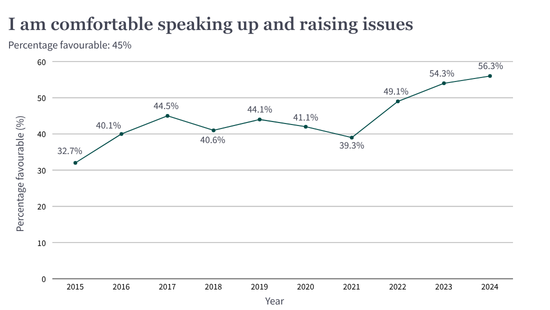
Encouragingly, results have improved in the last two years, with a sharp upward trend from 2022 through to 2024, the highest levels seen in the dataset.
The generational and tenure patterns suggest that comfort in speaking up may be closely linked to evolving employee expectations. Younger employees may enter the workforce with stronger expectations for psychological safety, having been raised in an era of more open dialogue on workplace wellbeing and inclusion.
For longer-serving employees, the reduction in openness to speaking up could stem from entrenched organisational norms, past experiences of not being heard, or a perception that speaking up won’t lead to change. The tenure effect might also be tied to hierarchical or procedural constraints that can make it harder for seasoned employees to challenge the status quo.
The positive upward shift since 2022 is a hopeful sign. It may reflect post-pandemic shifts towards more flexible, responsive leadership and the growing emphasis on employee engagement and psychological safety in local government.
Recommendations for building a “speak-up” culture in councils
To sustain and build on these gains, local government organisations can:
By actively addressing the barriers to speaking up, councils can strengthen trust, improve decision-making, and better serve their communities.
We can help. Our expertise lies in measuring employee perceptions through proven feedback methodologies and frameworks, offering expert advice to support your journey towards success.
If you think that we can help you here at Insync, please contact us.