Assessing willingness to pay (WTP) in price submissions and regulatory resets has a long and complex history in Australian utilities. This article unpacks some of our own experiences, which lie at the intersection of inclusivity, academic validity, regulator expectations, practicality, and the inevitable cost constraints faced by utilities.
Our story goes back a long way, but we’ll begin in 2016, when Victoria’s Essential Services Commission (ESC) introduced its PREMO framework. Built on the premise that “only customers know their preferences”, PREMO marked a shift in priorities from technical to allocative efficiency – in other words, it isn’t valuable to efficiently deliver experiences customers don’t want. If that was no longer the benchmark of success, though, how could regulators keep corporations accountable? In the worst-case scenario, utilities might sacrifice efficiency without truly understanding what customers wanted or were willing to pay for.
Enter, academic rigour. Fearing that risk, regulators sought confidence that customer research met the highest standards of economic discipline. This focus reached its peak in 2020 when IPART commissioned Gillespie Economics to review the WTP methods used by Hunter Water and Sydney Water, concluding that market research approaches lacked rigour. The paper’s impact was felt across Australia and beyond.
At Tingwall, we found this disappointing. Our view was that, in the utilities context, all choice models suffer from unacceptable degree of selection bias. As the Gillespie report put it, the purpose of strict protocols in economic WTP research is to “ensure respondent preferences are estimated as accurately as possible”. This is a worthy goal, but evidence suggests that people capable of responding to these surveys are rarely representative of the full customer base.
The stark reality is that most choice models demand a level of literacy and numeracy that excludes up to half of all customers from meaningfully representing their values and priorities in their responses. In 2006, the Australian Bureau of Statistics found that that one in seven adults could not read a simple bus timetable, and nearly half struggled with anything more complex. The most recent data from the OECD’s PIAAC survey showed little improvement, finding 44 per cent of Australians lack the literacy skills and 55 per cent the numeracy skills needed for daily life. If that many Australians find a bus timetable confusing, what chance do they have of completing a survey that asks them to weigh ten features, each with six options? Such techniques risk measuring confusion, not preference.
This example shows why regulators in Australia are well advised to acknowledge that there is a choice to be made between an academically valid study and an inclusive and universal one (the Gillespie Economics report suggested that IPART was very much on the academically valid side of the spectrum).
Meanwhile, a middle-ground approach was gaining momentum. In 2019, the Water Services Association of Australia (WSAA) had released a guideline on measuring customer willingness to pay in price submissions, emphasizing the need to balance rigour with inclusivity and consideration of expanding customer expectations. Regulator perspectives were evolving, too. The ESC, which had carefully refrained from prescribing any particular WTP technique, commissioned an academic to review of Melbourne Water’s use of SIMALTO in its 2021 price submission. In late 2022, IPART’s 3Cs framework signalled a softening of the rigid focus on academic validity implied by the Gillespie report. Then, in 2023, the ESC released its Getting to Fair strategy and ten principles of universal and inclusive engagement, and its price determinations that year set out three clear preferences:
Over the past 20 years, willingness-to-pay research in Australian utilities has moved through three distinct phases: from a paternalistic approach led by organisations that considered themselves the authority on water and energy, to one that prized academic rigour over reality, and now to a more balanced model grounded in both validity and inclusivity.
This is the context in which Tingwall has evolved its own approach.
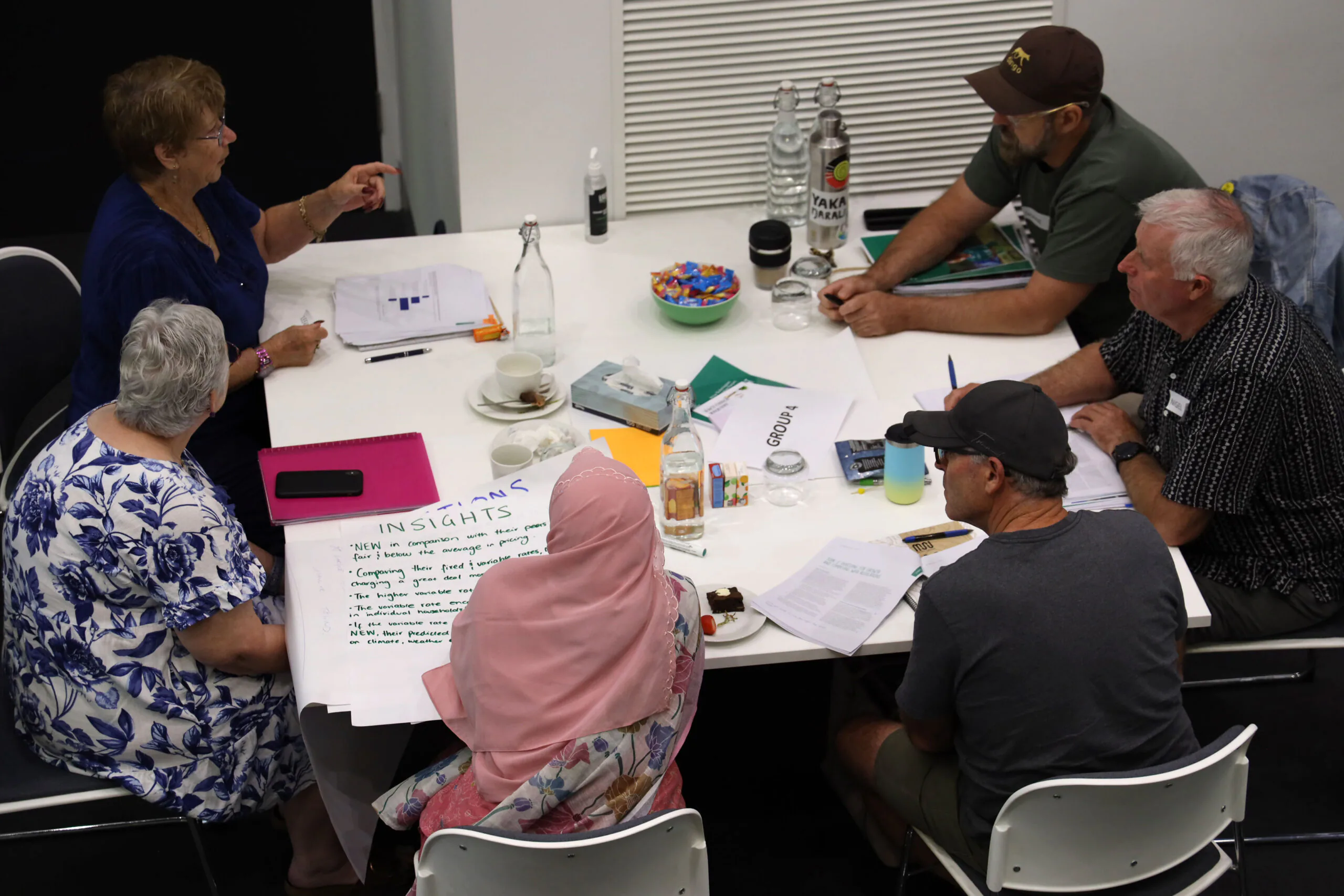
At the centre of our WTP research is our Bill Simulator, which combines academic rigour with a specific focus on maximising inclusivity. Consistent with regulatory expectations, the Bill Simulator sits within a broad engagement program, and we are very happy to report that its results have been thoroughly scrutinised, tested, and challenged in the deliberations that followed.
In some cases, we have seen deliberative panels endorse its findings. In others, they have advised acting on the preferences of financially vulnerable customers whose willingness to pay was well below average. In one instance, a panel concluded that respondents could not have fully understood the context of certain questions, and on that basis recommended doubling investment in several areas beyond what the simulator results suggested.
Each deliberation is strengthened by triangulating simulator results with focus group insights, Easy-English priorities surveys, and the informed perspectives of industry representatives and advocates, giving participants a deeper understanding of community priorities.
Today, regulators can be confident that proposals built on inclusivity, triangulation, and deliberation represent robust and well-considered evidence of customer willingness to pay. Meeting these expectations is a significant undertaking, however, demanding a broad range of research capabilities from the highly quantitative to the deeply qualitative. These include technology, sophisticated mathematics, sampling schemas, analysis, synthesis, bias checks, and deliberation. Our organisation has spent the last two decades gathering these competencies together under one roof. Today, we are specifically structured to bring them to bear on complex issues with significant price impacts and intergenerational ramifications.