
Written by Sanjaya Gunaratne, Senior Manager
Collaboration allows organisations to solve complex challenges by leveraging diverse perspectives, make more informed decisions, pool resources, and create cost efficiencies. A wealth of research shows that collaboration is key to high performance.
For over two decades, Tingwall has been studying employee perceptions in councils and our research shows that collaboration has been and continues to be a challenge for the local government sector.
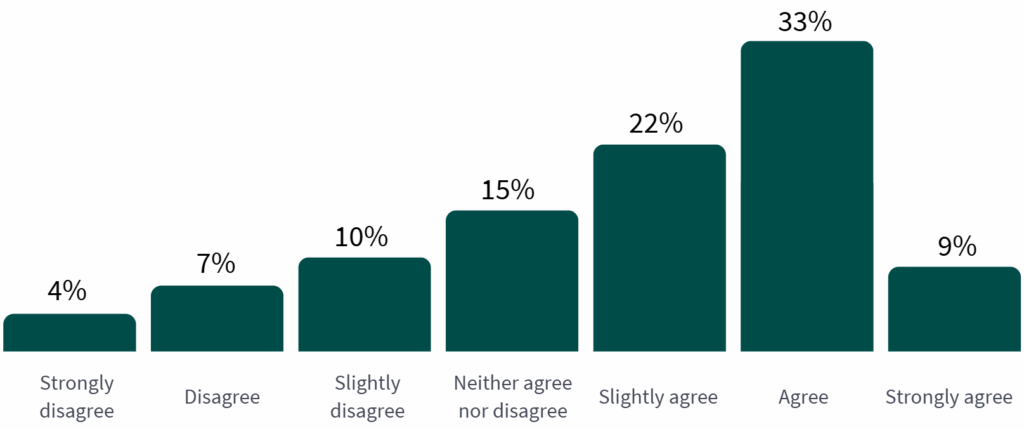
The graph below depicts the distribution of responses to the statement, ‘Departments in this organisation provide good customer service to each other.’ The dataset comprises nearly 21,000 responses from Australian local government employees.
You may be surprised that only four out of ten respondents agree that the different work groups at Council provide good customer service to each other. Moreover, one out of five respondents (21%) disagree with the statement.
Percent favourable: 42%
It is also interesting that the percent favourable score (percentage of participants that have agreed or strongly agreed) remains largely the same, irrespective of the size* of the council; between 39% (medium-sized councils) and 43% (small and large councils), as illustrated below.
Average percent favourable: 42%

We also asked participants if they believe their own team has a good customer service culture. The proportion of respondents who agree with this statement is almost double, at 77%. The proportion of those that disagreed is just 4%.
This data tells us that the issue with collaboration in local government is more to do with inter-team collaboration rather than intra-team collaboration. There seems to be a sentiment of ‘it’s not us, it’s them.’
*Councils were broken down by size based on response numbers (small = <200, Medium = 201 – 700 and Large = 701 and over).
When we conduct focus groups, we often ask local government employees how they believe collaboration can be improved. The suggestions typically fall into two categories: awareness and empathy.
With regard to awareness, understanding the importance of other functions’ roles and the goals they are trying to achieve is key. It is equally important to instil a sense of empathy by bringing into focus the challenges and hurdles faced by other teams. It is important for teams that regularly work together, to understand the benefits of collaboration and how a lack of it can be detrimental to the organisation, and the community.
“Individual commitment to a group effort – that is what makes a team work, a company work, a society work, a civilization work.” – Vince Lombardi
With a wealth of research supporting the significance of collaboration for business performance, it’s imperative to measure employee perceptions and ensure your organisation is perceived as a collaborative one.
We can help. Our expertise lies in measuring employee perceptions through proven feedback methodologies and frameworks, offering expert advice to support your journey towards success.
If you think that we can help you here at Tingwall, or you would just like to bounce some ideas around with us, please touch base.