At a time when public sector organisations face increasing scrutiny, tighter budgets, and growing community expectations, helping employees connect the dots between their daily work and the Council’s overall objectives has never been more critical. For local councils, ensuring that every team member understands how their role contributes to the organisation’s overall goals is not just a “nice to have”; it’s a key enabler of engagement, performance, and service delivery.
Since 2011, we’ve been tracking employee experience across the Australian local government sector. Our data, from over 46,000 local government employees, reveals one of the most encouraging trends we’ve seen in recent years: a steady improvement in employee perceptions of role clarity and alignment with the council’s goals. This article explores what our latest data is telling us and what councils can do to maintain that momentum.
Councils play a unique role in shaping the places we live, from maintaining local roads and parks to planning for climate resilience and community wellbeing. One of the significant advantages councils have is that their purpose is inherently community-focused. Unlike many sectors, there’s a strong altruistic element to the work: many employees know they are contributing to something bigger than themselves. This gives local government a powerful head start when it comes to creating meaning and purpose at work. This is also a unique value proposition that councils can offer staff.
But that sense of purpose can still be lost if employees don’t clearly understand how their individual role connects to the council’s broader goals. Creating alignment between day-to-day tasks and long-term community outcomes is a critical driver of engagement, motivation, and discretionary effort across the workforce.
The chart below, based on over 46,000 responses across 119 studies, shows the percentage of respondents who have agreed or strongly agreed with the survey statement: “I understand how my role contributes to Council’s goals.” After a period of relative plateauing between 2015 and 2020, we’ve seen a marked and consistent improvement in both favourable response rates and mean score since 2021.
Percent favourable 64%
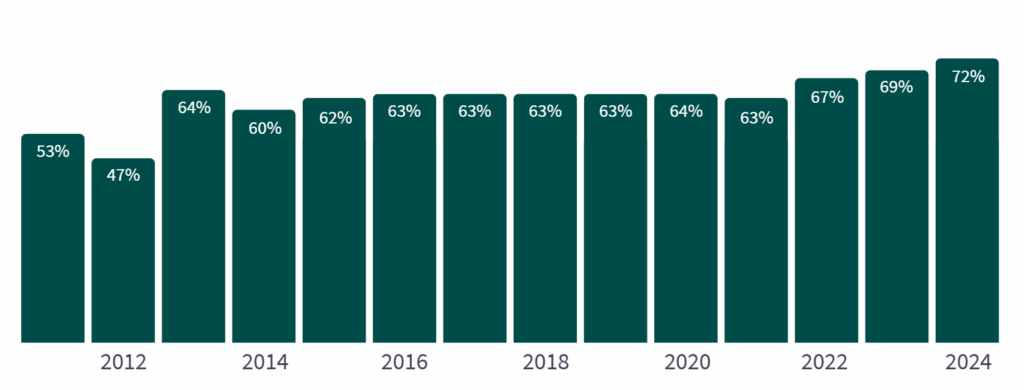
In 2020, 64% of respondents responded favourably. By 2024, this had risen to 72% – the highest it had reached in 14 years. What’s more is that in 2024, only 5% of respondents expressed any level of disagreement.
We’re seeing a similar trend with the statement, “There is a clear connection between what my team does and what the Council wants to achieve.” Since 2020, results have steadily climbed from 53% to 63% in 2024. That is the highest favourable response we have seen in the 14 years we’ve been tracking this.
Percent favourable 64%
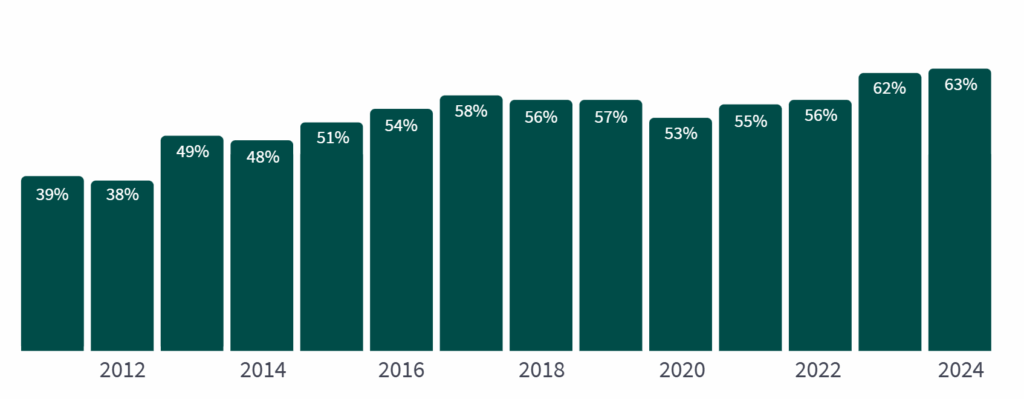
This positive trajectory suggests that councils have been putting more deliberate effort into strategic communication, goal setting, and helping employees connect their day-to-day tasks to larger organisational outcomes. It also reflects the increased focus that many councils have placed on internal communication and purpose-led leadership in the wake of COVID-19 and the associated workforce disruptions.
Despite the encouraging trend, there’s still room for growth. Across the sector in 2024, around one in four employees remain unclear about how their work links to the broader goals of the council. Here are a few practical steps leaders and teams can take:
As councils continue to evolve, the challenge is no longer just setting a clear direction – it’s ensuring every person across the organisation feels that they are part of the journey. Our data shows that a larger proportion of employees are making that connection.
Is your council looking to create better alignment between day to day tasks and the bigger picture? Start by assessing your current employee sentiment and engagement. If you’re unsure where to begin, reach out to our friendly team to learn how we can support you.